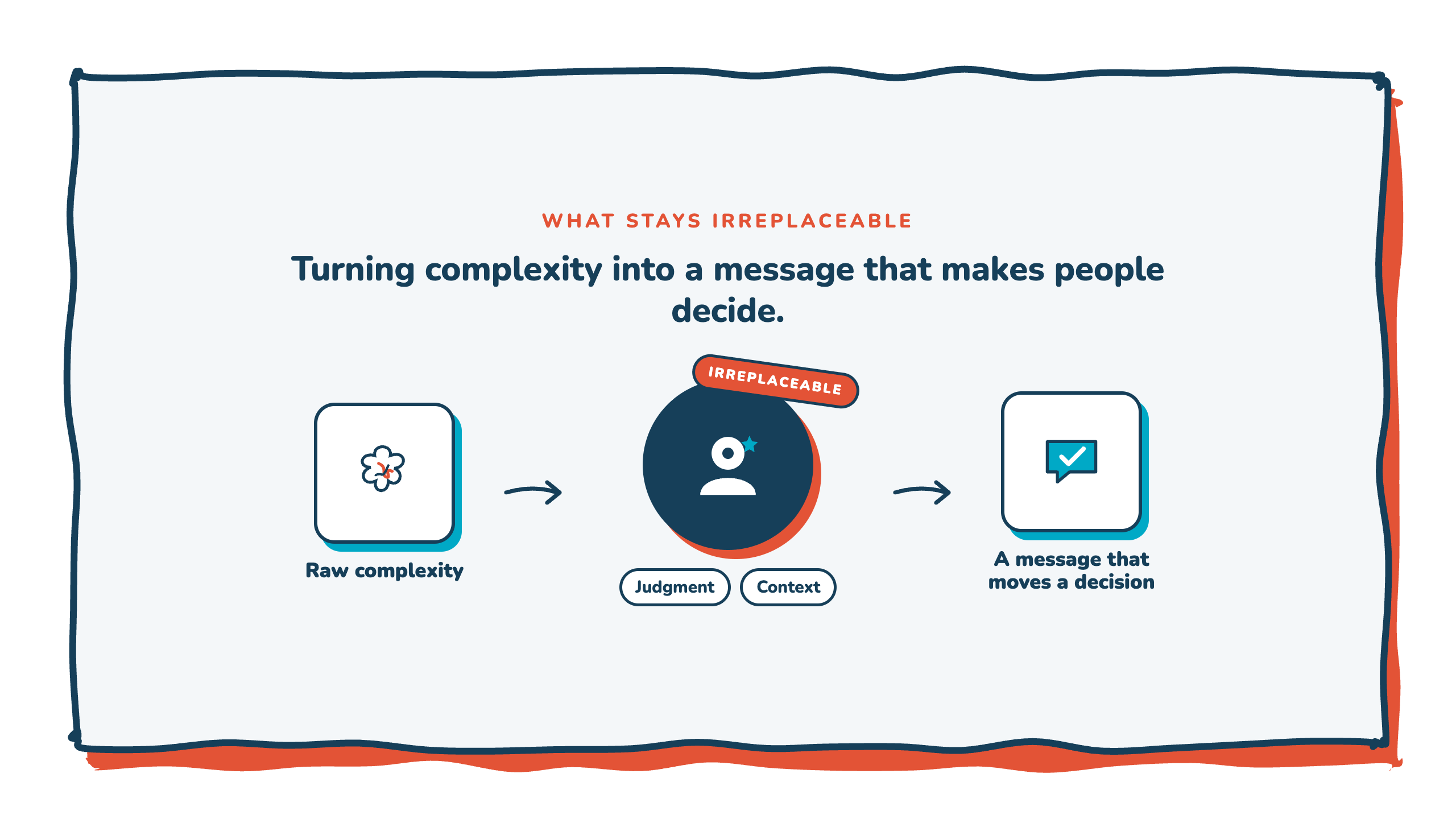
Four industrial revolutions in, and complex communication is still a human responsibility.
The Pattern Every Revolution Follows
Each industrial revolution has followed the same logic: automate what is repetitive, eliminate what is inefficient, and redeploy human effort toward what machines cannot yet do. The first revolution mechanized physical labor. The second standardized production. The third digitized information. The fourth is automating cognition itself, pattern recognition, language generation, data synthesis, and content production at scale.
Each time, the same argument surfaced: this time, human roles will be eliminated entirely. Each time, that argument was partially right and mostly wrong. Tasks were automated. Functions were not. The higher-order work, the work that requires judgment, context, and the ability to navigate ambiguity, moved up the value chain rather than disappearing.
Machines can generate content. They cannot design a communication framework.
The One Thing Automation Cannot Do
Automation is excellent at execution. It can produce, distribute, optimize, and measure. What it cannot do is determine what needs to be said, to whom, in what order, and with what framing. That is not a technical problem. It is a strategic one.
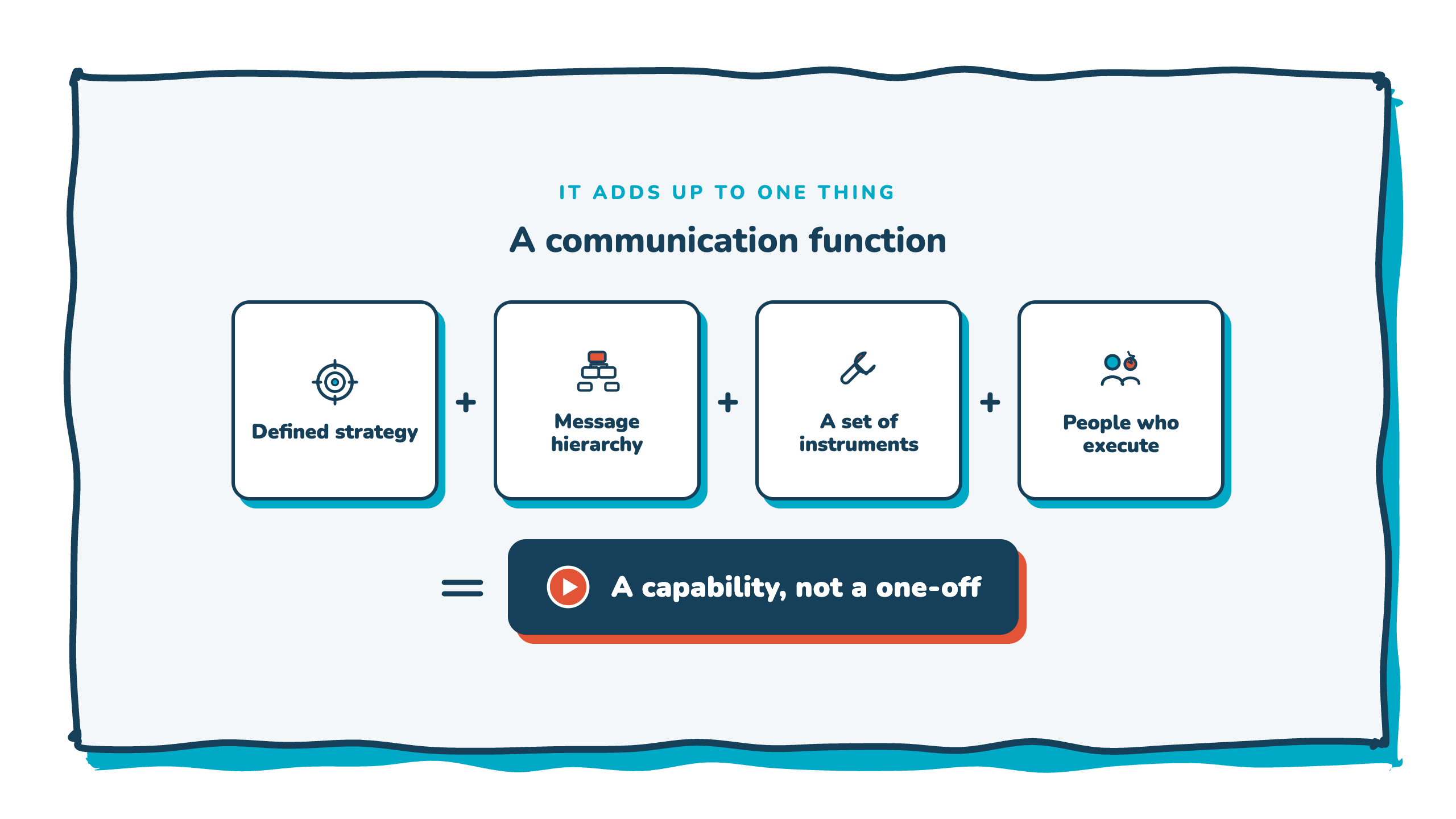
A defined strategy, a message hierarchy, a set of instruments aligned to specific audiences and objectives: these require human judgment. They require someone who understands the organization, the stakes, the audience, and the communication gap between them. That understanding cannot be automated. It can only be applied.
Clarity under complexity is not a soft skill. It is an organizational capability.
What this Means for Organizations Under Pressure
When markets shift fast, the organizations that communicate clearly have a structural advantage. They move decisions faster. They align teams with less friction. They build credibility with external audiences during the moments when credibility is hardest to maintain.
The organizations that struggle are not the ones with fewer resources. They are the ones without a communication framework. They produce more to compensate for clarity they do not have. The volume increases. The impact does not.
The Case for Building Communication as a Function
The investment most organizations defer the longest is the one that would have saved them the most. Building communication as a function, not a campaign, not a content calendar, not a production budget, but a system with a strategy behind it, is what separates organizations that communicate clearly from those that are simply present.
That function does not require a large team. It requires a clear framework, the right instruments, and a communication firm that knows how to build both.