


When the conditions are everything but ideal and the deadline is immovable, the brief itself becomes the instrument.
When the Brief Arrives with No Margin
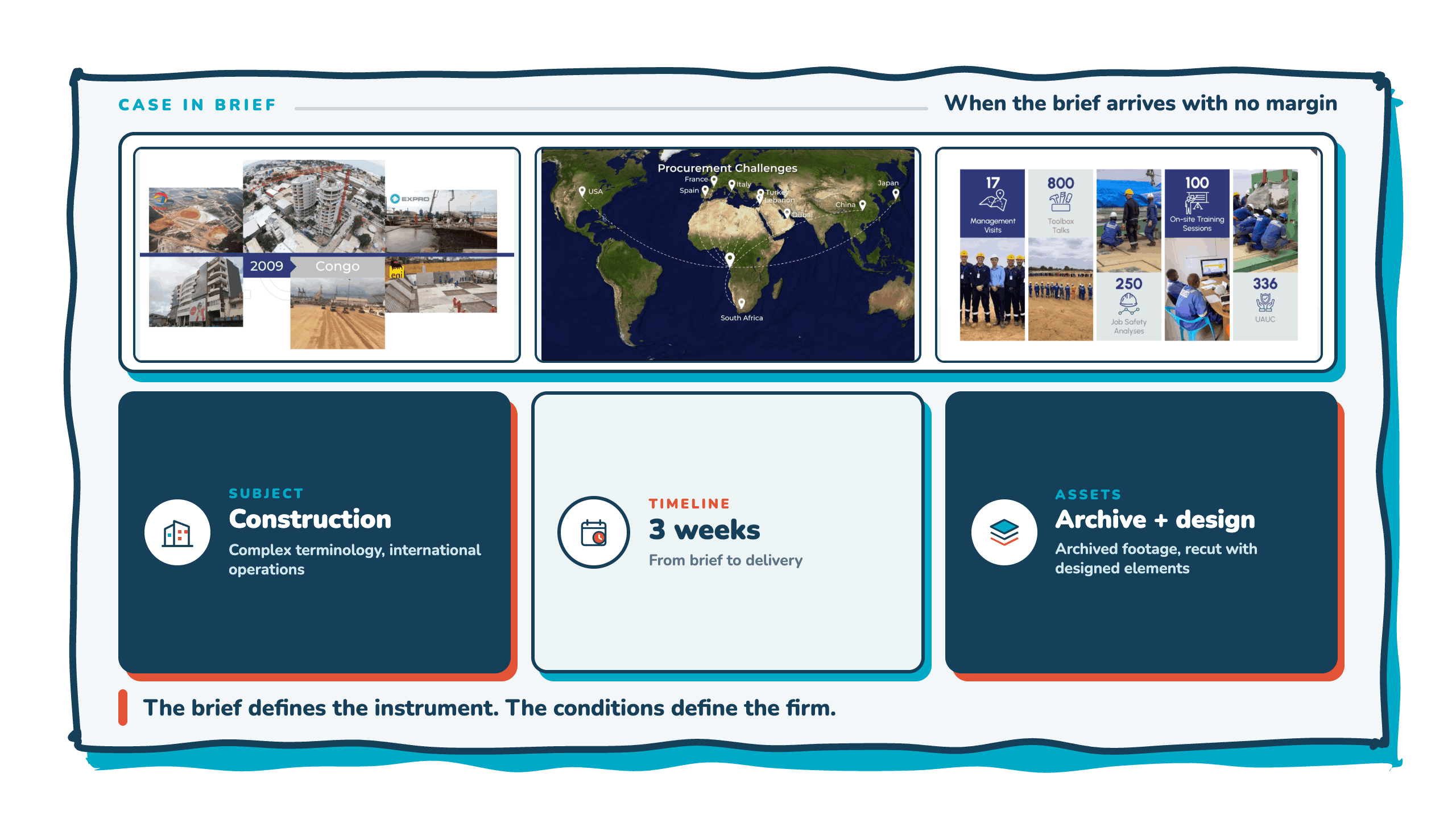
Some projects define themselves from the first call. Zerock, a large construction company operating across Sub-Saharan Africa, needed four corporate communication instruments for an executive meeting. The deadline was three weeks away. The construction sites were in remote international locations. There was no footage, no time to film, and a subject matter dense enough to require expertise before it could be simplified.
This is executive communication at its most demanding: a C-suite audience, a non-negotiable date, and a subject most firms would decline because the conditions were not right.
We did not decline.
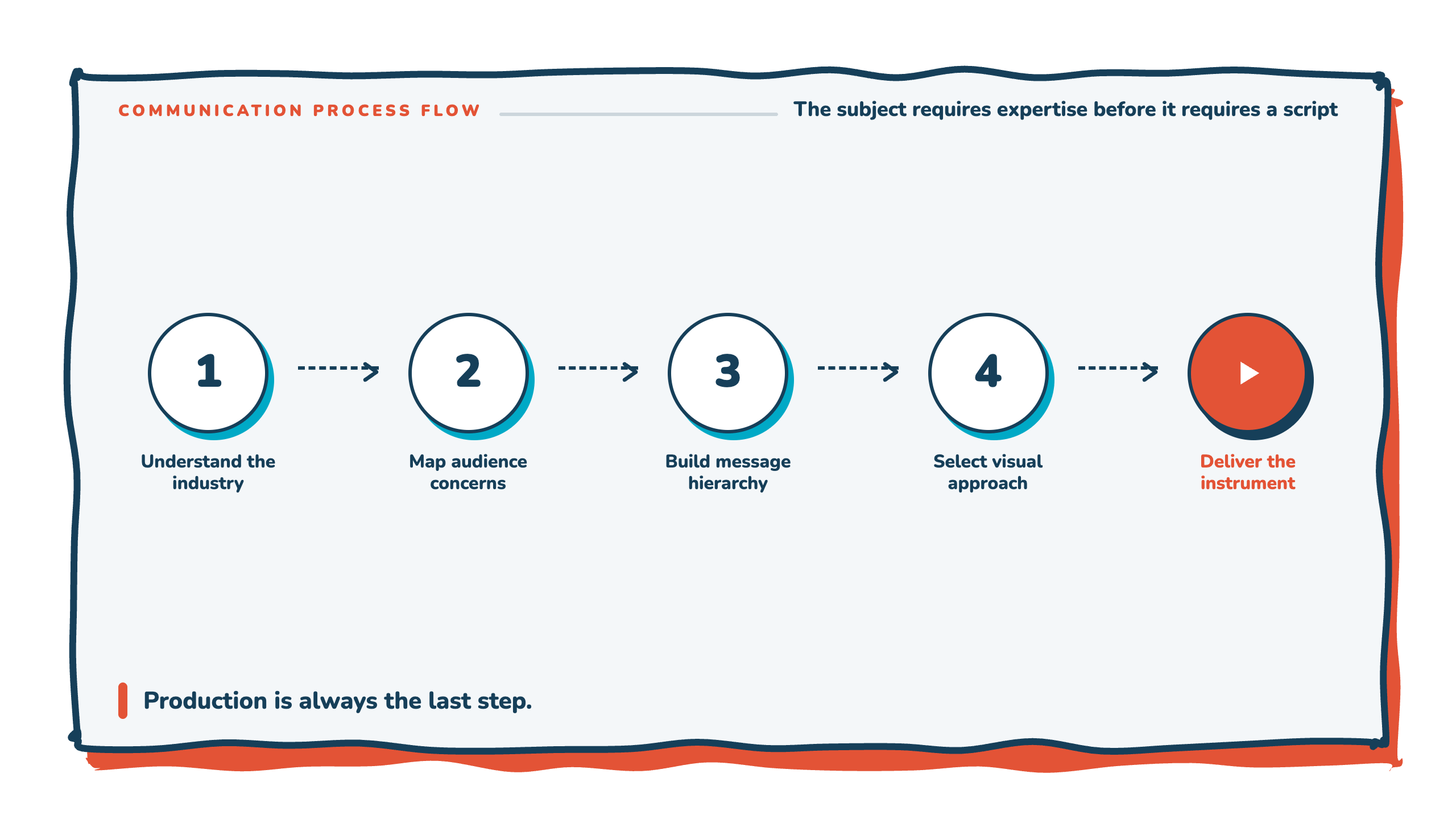
The Subject Requires Expertise Before it Requires a Script
The first challenge was not the deadline. It was the subject itself. Construction industry communication operates in a language of its own, technical, specific, and unforgiving of approximation. To simplify that complexity for an executive audience, you first have to understand it completely.
For every project in a technical sector, we assemble a team that includes professionals with relevant industry experience. Not consultants brought in for appearances. People who understand the terminology, the operational logic, and the decisions being made at the top. That expertise is what makes it possible to move from complexity to clarity without losing what matters.
This is the step that precedes any production. Before the script, before the visual approach, before the instrument is built. In a three-week window, that step had to happen in days.
To simplify complexity for a C-suite audience, you first have to understand it completely.
When There is No Footage
The absence of visual materials is a constraint many firms treat as a reason to stop. Remote construction sites in the Republic of Congo could not be filmed in time. The client had no archive, no photography, no reference footage suitable for an executive presentation.
We worked with what was there and engineered the rest. A mix of visual approaches, archived footage, motion graphics, animation, and a consistent design language applied across all four instruments. All carried the weight of content that would have been filmed if conditions had allowed. The instruments remained visually cohesive across four distinct subjects, each strategically tailored to address a specific concern the executive audience would bring to the meeting.
A well-constructed communication instrument can carry complex information with precision even when it is built entirely from mixed media elements. The question is always what the audience needs to understand, in what order, and with what level of density. Everything else follows from that.
Working at the Speed of an Executive Deadline
Three weeks is not a production timeline. It is a communication emergency. And it requires a different way of working, one that removes friction from decision-making at every point.
We held multiple in-person meetings with the CEO to understand his vision directly and reduce turnaround time. Between sessions, communication ran near-continuously, up to fourteen hours a day, seven days a week so that approvals, revisions, and direction changes moved at the speed the deadline required. This is not an exceptional approach. It is what becomes necessary when the margin for delay is zero.
When the meeting date is fixed and the instrument does not yet exist, everything else becomes secondary to delivery. The team, the process, and the communication architecture between client and firm have to operate as a single system.
When the margin for delay is zero, the process has to move like the deadline already passed.
The Result and What it Demonstrates
The instruments were completed ahead of the meeting. The management was satisfied. And the executive presentation went ahead with four communication instruments, each built to address a specific concern of the C-suite audience.
What this project demonstrates is not a particular technique. It is a way of operating. Working under constraint is not a compromise. It is a form of communication engineering that requires precision at every step: understand the subject, build without perfect materials, move fast without losing coherence, and keep the audience at the center of every decision.
Most firms need the right conditions to begin. Our best work tends to happen when the conditions are the problem.