


When Referrals Are No Longer Enough: Why Industrial Businesses Need a Communication Strategy
Referrals open doors, but buyers now research suppliers on their own. Why industrial and B2B businesses need a communication strategy before they invest in new communication instruments.
A strong reputation remains valuable, but on its own it may no longer communicate the full value of a business.
For years, many businesses built their reputation without a formal communication department. Their work spoke for itself. Clients came through referrals, established relationships, industry networks, tenders, and a physical presence in the markets they served.
This model worked. And for many businesses, it still does.
However, the way potential clients discover, assess, and select suppliers has changed. A recommendation may open a door, but what happens when a potential client visits the company's website, searches for its expertise, compares its competitors, or needs to understand its capabilities before agreeing to a meeting?
A strong reputation remains valuable. But reputation alone may no longer be enough to communicate the full value of a business.

The Industries Facing This Shift
This challenge is particularly relevant to businesses in construction and contracting, engineering and infrastructure, energy and utilities, manufacturing, logistics, agriculture, wholesale and distribution, and other business-to-business sectors.
This does not mean that these industries have never invested in communication. Large corporations across these sectors have long maintained sophisticated corporate communication functions. The challenge applies mostly to small and medium-sized enterprises and established businesses whose commercial operations developed faster than their communication capabilities.
Being Present Online is Only the First Step
Many businesses have recognized the need for a website, a LinkedIn page, or a regular social media presence. Yet having these channels does not necessarily mean that the company is communicating effectively.
Research reinforces this distinction. A Gartner survey published in June 2025 found that 61% of B2B buyers prefer an overall buying experience without a sales representative. Buyers increasingly conduct independent research, but they still need relevant information and expert guidance when evaluating suppliers. Much of the evaluation now happens before the first conversation.
For an industrial business, a digital presence should therefore do more than confirm that the company exists. It should help a prospective client understand what the company does, what distinguishes it from competitors, which problems it can solve, and why it should be considered for a particular opportunity.
More importantly, communication must support a business objective.
A company entering a new market may need to establish credibility with unfamiliar stakeholders. A contractor competing for larger projects may need to demonstrate experience and delivery capabilities. A manufacturer may need to reposition its offering to reach a different segment of customers. A family-owned business preparing for expansion may need to communicate a value proposition that has evolved beyond its traditional reputation.
Each situation requires a different approach.
The right communication instrument depends on the business objective, not the other way around.
Why Companies Struggle to Decide What They Need
Many businesses recognize that their communication needs to evolve, but they are not always certain where to begin.
Some start by investing in individual instruments, such as a new website, a company presentation, social media posts, or a corporate film. Others postpone action because they are unsure which investment would be most useful or how to evaluate its contribution.
Designers, writers, and production specialists can play an important role in developing effective communication instruments. However, the value of these instruments depends largely on the strategic direction guiding them.
Without a clear understanding of the business context, competitive positioning, target audiences, and intended outcomes, communication activities can become disconnected from one another. The company may repeat similar messages across different platforms without progressively strengthening its market position or supporting a specific business initiative.
Buyers notice. The same Gartner survey found that 69% of B2B buyers report inconsistencies between the information on a supplier's website and what its sales representatives tell them.
The answer is not necessarily to produce more. It is to establish what the communication needs to achieve before deciding what to produce.
Start with a Diagnostic Assessment
At Business Motion, communication starts with the business objective.
Since 2014, we have worked with organizations in complex industries, developing communication approaches tailored to their activities, requirements, and commercial context. Most of these projects arrive with real constraints: a tight deadline, missing assets, a fragmented brand, or an audience of board members. We work with what is there and engineer the rest.
Our process begins with a diagnostic assessment. We examine the company's current communication, market positioning, competitive environment, audiences, and existing resources. We clarify its short-term objectives and long-term ambitions, then identify the gaps between where the business stands and what it needs to communicate to move forward.
This assessment establishes the foundation for a communication strategy.
The strategy defines the direction: the priorities, audiences, messages, channels, and criteria for evaluating results. It also guides the selection of the appropriate communication instruments, ensuring that each serves a defined purpose rather than becoming an isolated activity.
The requirements of a company strengthening its positioning will not be the same as those of a company supporting a tender or communicating a complex project. Nor will the solution be identical for a young company and an established business with decades of experience.
The strategy must reflect the business, not force the business into a standard communication package.
From Business Objectives to the Right Instruments
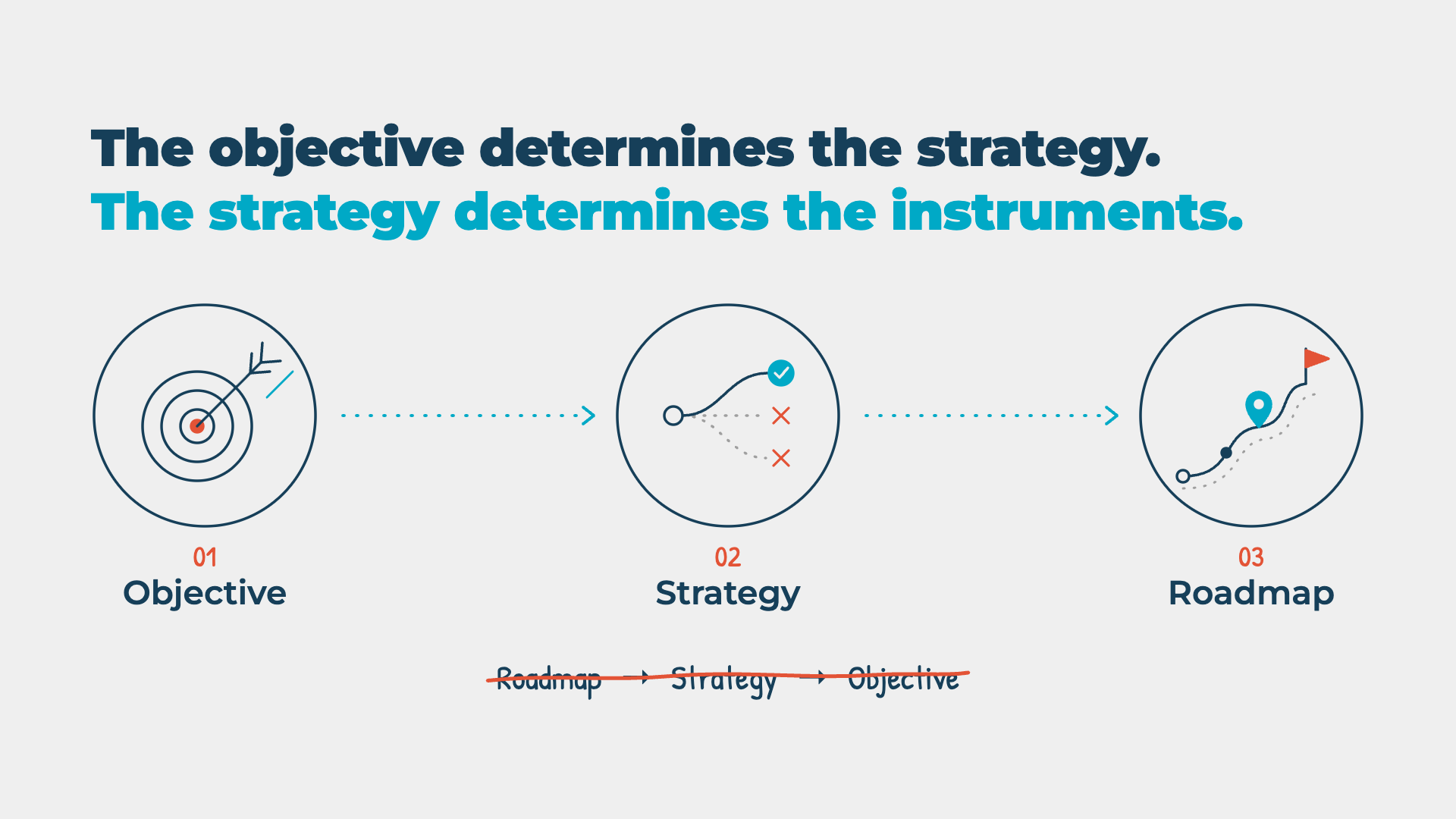
Communication is most effective when the objective determines the strategy, and the strategy determines the instruments.
A company repositioning itself, for example, may need a consistent narrative across its website, presentations, leadership communication, and other channels. A company preparing a bid may need something else entirely. The instruments are different because the objectives are different.
This is the approach Business Motion brings to communication: first, establish what the business needs to achieve; then assess its context and position; develop the strategic direction; and identify the instruments required to support it.
The objective is not simply to make a company more visible. It is to make its value clear and relevant to the people whose decisions matter to its business.
Business Motion. A communication firm. We turn complexity into instruments that move decisions.